
|
Product Details:
Payment & Shipping Terms:
|
| Diameter: | Disc Diameter φ250mm | Speed: | Disc 50-600rpm |
|---|---|---|---|
| Loading: | 5–150 Newtons (N) | Sample: | Diameter 30mm |
| Dwell Time: | 60–999 Seconds (s) | Power: | 700W |
| Highlight: | Automatic Grinding Polishing Machine 320W,200N Automatic Grinding Polishing Machine |
||
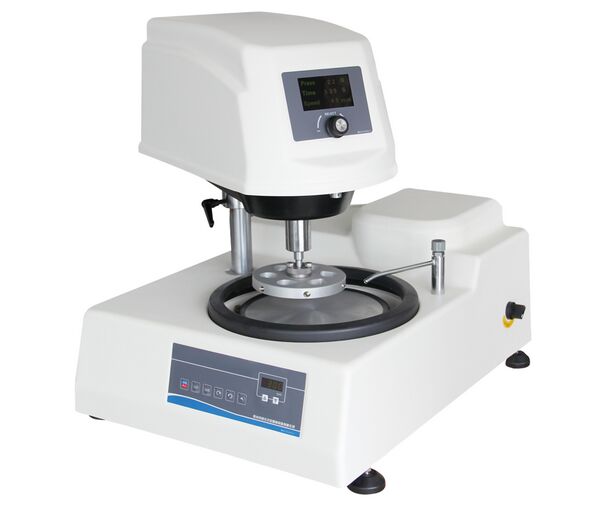
Center Loading LCD
Display Automatic Grinding And Polishing Machine With Polishing Head
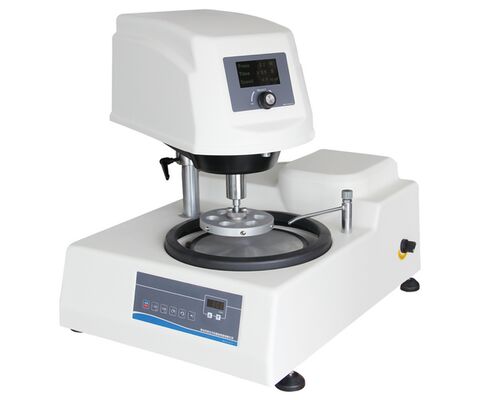
Model: iGrind-822
Download Technical Data: Grinding Polishing Machine iGrind-822
Brief Introduction:
The iqualitrol iGrind-822 automatic grinding and polishing machine is a single-disc, benchtop unit that, in accordance with international standards and utilizing state-of-the-art manufacturing technologies, represents a new generation of high-precision, automated sample-preparation equipment.
iGrind-822 features freely selectable rotation directions for the grinding/polishing platen, quick-change platen capability, a multi-sample holder, and mechanical center-force loading, as well as automated abrasive delivery.
Equipped with an advanced microprocessor control system, the machine enables stepless speed adjustment of both the grinding/polishing platen and the polishing head, while sample preparation pressure and time settings are intuitive and easy to configure.
Simply by changing the grinding/polishing platen or the abrasive paper and fabric, the grinding and polishing processes can be completed, thereby endowing the machine with even broader applicability.
iGrind-822 equipped with a water-cooling system that cools the specimen during grinding, thereby preventing overheating and subsequent degradation of the metallographic structure.
Coupled with an ABS housing and stainless-steel standard components, it boasts a more elegant and refined appearance, enhanced corrosion and rust resistance, and easy cleaning. In addition, the machine features smooth rotation, high safety and reliability, a compact design, and low noise levels.
iGrind-822 is designed for automated sample preparation, covering the entire workflow from rough grinding and fine grinding to coarse polishing and fine polishing of metallographic specimens. It is an ideal sample-preparation instrument for laboratories in enterprises, research institutions, and higher education institutions.
Technical Specifications:
| Grinding and polishing disc diameter | φ250mm |
| Polishing pad rotational speed | 50–600 r/min (stepless speed regulation); 150 r/min and 300 r/min (two-speed fixed-speed) |
| Grinding and polishing head speed | 50–100 r/min (stepless speed regulation) |
| Loading range | 5–150 newtons (N) |
| Sample preparation time | 60–999 seconds (s) |
| Specimen diameter | φ30mm (customizable) |
| Input voltage | Single-phase AC 220V 50Hz |
| Input Power | 700W |
| External dimensions | 632×750×700 (mm) |
| Net weight | 72kg |

Surface layers damaged by cutting must be removed by grinding. Mounted specimens are ground with rotating discs of abrasive paper, for example wet silicon carbide paper. The coarseness of the paper is indicated by a number: the number of grains of silicon carbide per square inch. So, for example, 180 grit paper is coarser than 1200 grit.
The grinding procedure involves several stages, using a finer paper (higher number) each time. Each grinding stage removes the scratches from the previous coarser paper.
This can be easily achieved by orienting the specimen perpendicular to the previous scratches. Between each grade the specimen is washed thoroughly with soapy water to prevent contamination from coarser grit present on the specimen surface. Typically, the finest grade of paper used is the 1200, and once the only scratches left on the specimen are from this grade.
Polishing discs are covered with soft cloth impregnated with abrasive diamond particles and an oily lubricant or water lubricant.
Particles of two different grades are used: a coarser polish - typically with diamond particles 6 microns in diameter which should remove the scratches produced from the finest grinding stage,
and a finer polish – typically with diamond particles 1 micron in diameter, to produce a smooth surface.
Before using a finer polishing wheel the specimen should be washed thoroughly with warm soapy water followed by alcohol to prevent contamination of the disc. The drying can be made quicker using a hot air drier.
Mechanical polishing will always leave a layer of disturbed material on the surface of the specimen. Electropolishing or chemical polishing can be used to remove this, leaving an undisturbed surface.
Contact Person: Mr. Raymond Chung
Tel: 86-13711988687
Fax: 86-769-22784276
| Factory Address:No. 88 Jiaolian Yiheng Rd, Wanjiang District, Dongguan, China, 523046 | |
| Sales office:Room 301, Building No.1, No. 2 Jiaolian Yiheng Rd, Wanjiang District, Dongguan, China, 523046 | |
| +86--13711988687 | |
| sales@iqualitrol.com | |